
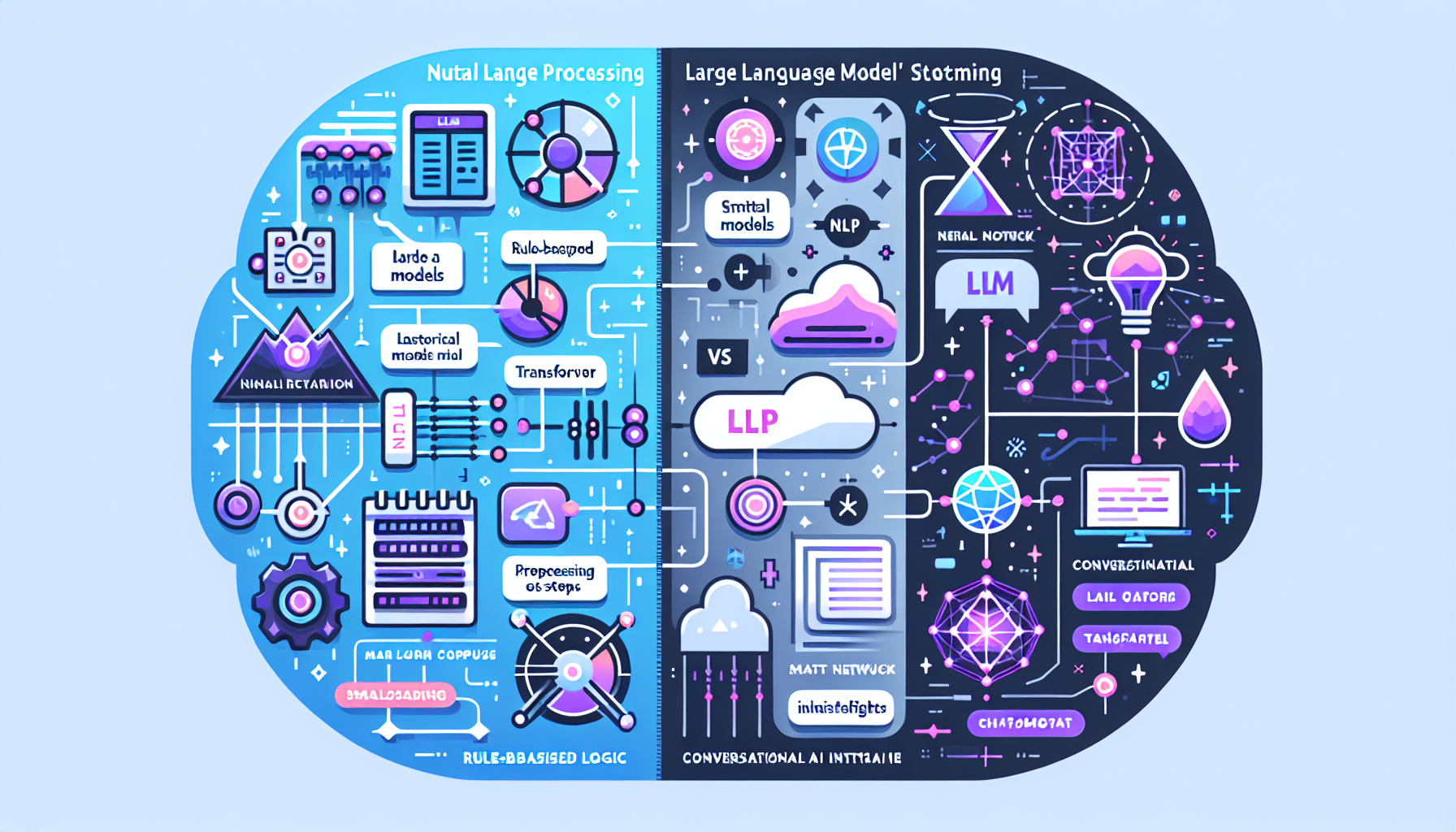
Artificial Intelligence has fundamentally changed how digital marketing operates. From automated content generation to customer sentiment analysis, AI-driven systems now assist marketers in understanding and engaging audiences at scale. However, many professionals use the terms NLP (Natural Language Processing) and LLM (Large Language Model) interchangeably without fully understanding their distinctions.
If you are building AI-powered marketing systems or planning to integrate automation into your campaigns, understanding the difference between NLP vs LLM is essential. While both operate in the language intelligence space, their scope, architecture, and applications differ significantly.
In this guide, we will break down NLP vs LLM in a structured, practical way, and explore their real-world relevance in digital and AI marketing strategy.
Understanding the Concept NLP vs LLM
Natural Language Processing (NLP) is a branch of artificial intelligence focused on enabling machines to understand, interpret, and generate human language. It combines computational linguistics with machine learning techniques to process text and speech data.
Traditionally, NLP systems were designed to perform specific tasks such as:
- Text classification
- Sentiment analysis
- Named entity recognition
- Language translation
- Chatbot response matching
NLP models can range from rule-based systems to machine learning classifiers.
On the other hand, a Large Language Model (LLM) is a type of advanced NLP model built using deep learning—particularly transformer architectures. LLMs are trained on vast amounts of text data and are capable of:
- Context-aware text generation
- Conversational responses
- Content summarization
- Code generation
- Multi-step reasoning
In simple terms:
- NLP is the broader field concerned with language processing.
- LLM is a sophisticated subset within NLP that uses large-scale neural networks to understand and generate language.
An analogy: NLP is like the discipline of mechanical engineering, while LLMs are high-performance engines built using modern engineering advancements.
Why This Matters in Digital Marketing
Understanding the distinction between NLP vs LLM is strategically important for marketers because they solve different business problems.
Traditional NLP is useful for:
- Categorizing customer feedback
- Filtering spam
- Identifying sentiment in reviews
- Extracting keywords from user queries
LLMs, however, enable:
- Long-form content generation
- Intelligent chat assistants
- Personalized email drafts
- Dynamic ad copy creation
- AI-powered campaign strategy suggestions
If your goal is structured analysis of customer data, lightweight NLP tools may be sufficient. But if you are aiming for advanced conversational engagement or scalable content production, LLM-powered systems are more relevant.
From a budget and infrastructure perspective, this difference impacts:
- Tool selection
- API costs
- Integration complexity
- Model maintenance
Therefore, marketing leaders must understand NLP vs LLM to choose the right solution for the right marketing task.
How It Works in Real-World Scenarios
Let us examine practical marketing use cases.
Scenario 1: Sentiment Analysis on Product Reviews
A mid-sized ecommerce company wants to gauge customer satisfaction.
A traditional NLP model can:
- Tokenize text
- Classify sentiment as positive, negative, or neutral
- Extract key complaint themes
This is structured and task-specific.
Scenario 2: AI Chat Assistant on Website
An education brand wants a chatbot that answers complex, contextual queries about courses, eligibility, pricing, and career paths.
Here, an LLM works better because it:
- Understands multi-layered questions
- Maintains conversational context
- Generates natural responses
- Handles diverse queries without rigid rules
Scenario 3: Content Marketing Automation
For scalable blog drafting, email campaigns, or ad copy, LLMs outperform traditional NLP due to their generative capability.
In summary:
- Use NLP for structured language tasks.
- Use LLMs for contextual, generative, and conversational tasks.
Tools and Technologies Involved
Understanding tooling helps professionals build implementation clarity.
Classic NLP Tools:
- NLTK
- spaCy
- Stanford NLP
- TextBlob
- Scikit-learn (for classification)
These are often used for pattern-based or supervised learning tasks.
LLM-Based Platforms and APIs:
- GPT-based systems
- BERT and its variations
- Claude models
- Gemini models
- Open-source transformer models (via Hugging Face)
Infrastructure considerations for LLMs include:
- GPU/Cloud computing requirements
- API usage pricing
- Token limits
- Prompt engineering strategy
- Fine-tuning capabilities
From a marketing operations perspective, most businesses integrate LLMs through APIs rather than training models from scratch.
Common Mistakes Beginners Make
Professionals entering AI marketing often misunderstand the scope of these technologies.
1. Assuming LLMs replace all NLP systems
LLMs are powerful but not always cost-efficient for simple classification tasks.
2. Ignoring Prompt Design
LLMs require strong prompt engineering for reliable output. Beginners treat them like search engines.
3. Overlooking Data Privacy
When using LLM APIs, sensitive marketing data must be handled carefully.
4. Confusing Automation with Intelligence
Just because a system generates text fluently does not mean it understands business strategy.
5. No Human Validation
AI-generated content must be reviewed for accuracy, tone alignment, and compliance.
Understanding these boundaries protects marketing teams from operational risks.
Myths vs Facts
Myth 1: NLP and LLM are the same.
Fact: LLM is a subset within NLP, built using deep neural networks.
Myth 2: LLMs always provide accurate information.
Fact: They generate probabilistic outputs and may produce errors or hallucinations.
Myth 3: Traditional NLP is outdated.
Fact: For structured tasks like spam filtering and keyword extraction, classic NLP remains highly efficient.
Myth 4: You need coding knowledge to use LLMs.
Fact: Many platforms offer no-code interfaces, though deeper integration requires technical skills.
Clarity around myths helps marketers adopt AI responsibly.
Skills You Need to Master This
For professionals in AI marketing, the following skills are increasingly valuable:
Foundational Knowledge:
- Basics of machine learning
- Understanding of language models
- Data preprocessing concepts
Practical Skills:
- Prompt engineering
- API integration basics
- Data interpretation
- Performance evaluation
Strategic Skills:
- Identifying business use cases
- Aligning AI tools with marketing goals
- ROI analysis
- Risk assessment
Marketers must move beyond tool usage and develop analytical thinking around AI deployment.
Career and Industry Relevance
The distinction between NLP vs LLM directly impacts career positioning.
Roles influenced by these technologies include:
- AI Marketing Strategist
- Marketing Automation Specialist
- Conversational AI Designer
- Martech Consultant
- Growth Technologist
Organizations increasingly seek professionals who can:
- Evaluate AI tools critically
- Develop AI-integrated marketing funnels
- Ensure ethical AI usage
- Balance automation with brand voice consistency
As regulations, platform capabilities, and user behaviors evolve, foundational knowledge of NLP vs LLM architecture will differentiate professionals from superficial tool operators.
Those who understand both technical foundations and marketing application will remain relevant over the long term.
Final Thoughts
Understanding NLP vs LLM is more than a technical distinction—it is a strategic insight for modern marketers. NLP provides the foundational framework for language processing, while LLMs represent an advanced evolution that enables contextual, generative intelligence.
Used correctly, both technologies can enhance customer insights, automate workflows, and improve communication efficiency. Used incorrectly, they can lead to misinformation, increased costs, and inconsistent brand messaging.
The key lies in selecting the right approach for the specific marketing objective.
This content is intended for educational purposes. Tools, platforms, and strategies may evolve over time, and implementation should be adapted based on business goals and industry context.
AI marketing is not about blindly adopting the most powerful model. It is about understanding the underlying mechanism, aligning it with strategy, and applying it with professional discipline.
If you found this post helpful, explore more practical resources and stay connected for regular updates, tips, and new posts.
Explore: Blogpost | Medium | Pinterest
Follow: Instagram | Facebook| Linkedin